The Halo Effect and How We Fool Ourselves

The Halo Effect is a cognitive bias where, because something has one positive attribute, other positive attributes are automatically believed of it. We all have these biases. It may be in politics or, as we’re going to look at here, the health and fitness world.

Here are 3 different ways the halo effect can fool us.

If people like the way a personal trainer’s body looks, it may be assumed that the trainer is qualified and really knows fitness and nutrition. That may not be the case. They may have taken far longer than needed to achieve their body’s condition. They may only be able to train others that are just like them. They may have injured themselves along the way. I’ve seen many people that have great bodies do some really dumb things.

helo-effect

Because a food is “organic” or “all natural”, we may believe it is healthy for us. We throw a halo over them and think that they are all healthy and all ok to eat. Well, organic brownies still have fat, sugar and a lot of calories in them. Organic foods still has to fit in our diet just like it’s non-organic counterpart. “All natural” certainly sounds good, but when you think about how that includes arsenic and poison ivy, you might not want to ingest them.

The halo effect can also apply to our behaviors.

Maybe you ate an entire pizza, but rationalize that it’s ok because you had diet soda. You’ve given the diet soda more power than it deserves. It may not add to the calories of the pizza, but it also doesn’t take any away from the pizza.

Let’s say you just exercised. Under the halo of something good that you have done, you feel you deserve a treat. A typical workout might burn 300-500 calories. So, now you want your treat, the Starbuck’s Pumpkin Spice Frappuccino. That Frappuccino has 450 calories in it, essentially nullifying the caloric expenditure of your workout. That may be fine if you are not trying to lose weight, but if you are, you need to rethink the treat.

We’re not going to be able to completely stop our use of the halo effect or cognitive biases in our lives. Most times we are completely unaware that we are doing it. We can, however, try to become more aware by starting to question the rationale for our choices.  If a decision could have an impact on your goals, stop and ask yourself if you are assuming more than the facts show.

Good luck.

Fear and the Spiraling of Disability as We Age

It used to be thought that we lose strength, mobility, balance, and stamina as we age, because we age. Research has since shown us that that just isn’t the case. We lose these attributes, not because we’re getting older, but because as we get older, we stop challenging ourselves in these areas. Why is that?
I have a theory, but first let’s note that, according to the CDC, only 24.2% of the adult US population met the Physical Activity Guidelines for both aerobic and muscle-strengthening activity. So, without even taking aging into account, we’re not active enough. As we age, we tend to not move as much as we used to and as we do less, we are able to do less. Our loss of abilities is not from aging but from decreased use.
As we age, our bodies suffer from wear and tear and a potentially a lifetime of less-than-ideal habits. Our bodies will experience aches and pains and when it’s uncomfortable to move, we choose to move less. Hence, our loss in abilities. Top that loss off with a loss of confidence in our ability to move (less sure of our strength and balance) and we start to be afraid of what might happen if we tripped and fell or injured ourselves in some way. That fear causes an increase in cautiousness. We then back off even more movement as we try to protect ourselves. And the spiral of disability continues.
The beauty of our bodies is that we can regain those lost abilities by getting back to challenging them. We can improve our strength, mobility, balance, and stamina by retraining them. The fear that has been holding us back can be managed by adding in some safety precautions. Here are a couple of ideas to get you started.

  1. Safely challenge your balance by doing standing exercises with your back 6” away from the corner of two walls and face outward. In this position, if you lose your balance to the side or start to fall backward, you will be caught by the wall. You could also set two chairs on either side of you with the backs of the chairs facing you. This way, if you start to lose your balance you can grab the backs of the chairs for stability. Safe!
  2. Do more of the everyday tasks that have become difficult. If climbing stairs has become challenging, don’t do less of them. Do more. The more you do them, the easier it will get. Go ahead and take whatever safety precautions you need, but not so safe as to not challenge your strength and balance.
  3. Add more challenges one small dose at a time. To build back abilities and confidence, start slowly and add more as you’re able.

We have two things to consider here. The first is to not let ourselves get to the point where we question our lifestyle activity. Are we doing enough to maintain our strength, mobility, balance, and stamina? If we’ve gone too long without the necessary challenges and now feel afraid to move like we used to, can we safely reintegrate those activities so can regain our abilities and confidence? Both are possible. We just have to take the steps necessary to make it happen. Good luck

Snake Oils and Charlatans

We’re coming up on the new year. People are getting their New Year’s resolutions lined up and are seeking the way that they are going to accomplish them. BEWARE! There are plenty of people and companies ready to sell you the easiest, fastest, best way to get there even if what they’re selling doesn’t really work. They know that you’re desperate and you will buy into the dream.

There are things you can look for in promotional material or advertising for products or programs that are clues to its false advertising. These include:

  • Using definitive terms, such as “will”, “always”, “proven” (without actually scientific proof), or even “best” is usually a giveaway that it’s false advertising. Nothing always works! There are also too many options to claim “best”. Something could be the best within defined parameters, such as “the best coffee as rated by a panel of 12 coffee drinkers.” One indicator that it could be legit is that it’s not using definitive terms. Instead, they use terms like “can”, “may”, “seems to indicate”, “should” or other terms as well as citing the research that backs up the claim (if it’s based on actual research, not just generically “proven”, they will tell you).
  • Using themselves as proof. “Look what it did for me.” First off, they’re selling something and they want you to buy it. Of course they would say it worked for them.
  • Using a celebrity endorsements. This is not to say that celebrities don’t use the product, but is that the reason they got the benefit? They are paid to say that it works and there could be many reasons why they may look or feel good that are not product or program related.
  • Even using others’ testimonials is not a good bet. The placebo effect, the “if you believe it, it can actually help” scenario, may be why they got their results and which may not translate to you. (For more on the placebo effect click here.)
  • The best way to know if something really works is to look for the peer-reviewed research (in journals). Do an internet search using phrases such as “research studies on…” or “scientific evidence on…” and then check the sources, making sure that they are reputable.
  • When in doubt, if it sounds too good to be true, it probably isn’t true.

CNBC recommends, “When in doubt about whether a site or a claim is real, there are resources available such as FactCheck.org or APFactCheck. It’s also always worth seeing if the information is corroborated in mainstream news sources. For health information, authoritative sites to check include the Centers for Disease Control and Prevention and the World Health Organization.”

Don’t get fooled this season (or any other for that matter) and make sure you do more research on the product or program before you buy into it.

You’re Going to Fail Trying to Reach Your Goal!

You are, you know. Going to fail. I don’t mean ultimately. That’s really up to you, but somewhere along the way you will fail. Let’s face it, your goal is probably something challenging. Maybe it’s losing a certain amount of weight. Maybe it’s getting your cholesterol down. Maybe it’s being able to get up and down from the floor. Whatever it is, there will be times when you stumble on your path to achieving it.

Our perception of failing is typically tied to following our initial plan exactly. Perhaps part of your diet plan is, “I will not eat desserts.”, but then, you attend a birthday party and the birthday cake wins the battle. Afterward, you feel that you have failed, and then, a week later, some other dessert opportunity gets the better of you. “Why even bother! I’m such a failure! I can’t do this.” This is your turning point.

You have a number of choices you can make. Many, frustrated, just give up. Some, keep trying with the same plan and continue to fail and feel badly. Others look at their situation, analyze what happened that threw them off, and change their plan to better handle that situation. It’s all a big experiment. You have an idea of how it should go (your hypothesis), you test it, if it works…great. If it doesn’t, you look at why and make new plan with your next best guess. Test it, repeat, repeat, repeat until you ultimately reach your goal.

Don’t judge yourself for failing. Failing is a part of learning and learning is what’s going to get you to your goal.

So, fail away and embrace the experiment.

A New Way to Talk Fitness

This is just a quick invitation. I just started a Men’s Fitness After 50 club on Clubhouse. Clubhouse is an all audio app that would allow us to have real time discussions about fitness. I hope you’ll join me there. (I’ll even teach you how to use it) click here to join me. https://www.clubhouse.com/join/mens-fitness-after-50/ZUGfUrYC

A Weight is a Weight is a Weight (revisited)

Repost from 2018 (because it still applies and I still hear people touting “the best equipment”):

I had a call from someone inquiring if we offered kettlebell classes. He was disappointed to hear that we didn’t offer that class nor use kettlebells in our personal training. In spite of trying to explain that we could replicate almost every exercise with a dumbbell, it was a deal breaker. This post is going to give you the scoop on a lot of the trendy pieces of equipment out there.

external wts

Let’s start with external loading, meaning something that has weight that is outside of your body. This includes everything from a dumbbell to your grocery bag.

All things are acted upon by gravity (this is what gives it weight) and gravity’s force is perpendicular to the ground. This is why we need multi-angled benches in the gym. In order to change what muscles or area of muscles we are working, we have to change our body position since the direction of the force of gravity is fixed.

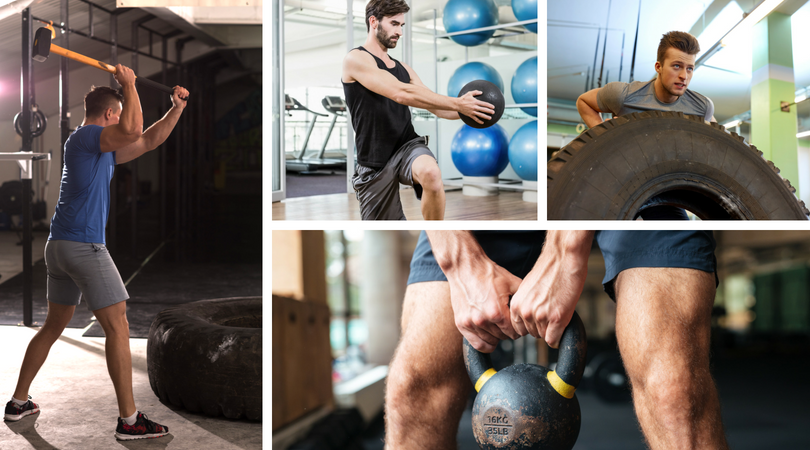
Your muscles do not know what you are holding. It only senses that what you are holding has weight. Your grocery bag could indeed be your workout tool. That said, there are kettlebells, sandbags, medicine balls, BodyBars, sledge hammers, tires, etc. all trying to be the next big training tool. So, what is the deal with all of these workout tools?

They are all external loads with just some minor differences.

Kettlebells: It’s a weighted ball with a handle on it. There a few movements that have a unique advantage because the leverage when held with the “ball” resting on the forearm or when inverted with the “ball” above the handle. Other than that… it’s just a weight.

Sandbags: Think, a sand weighted duffle bag. It’s a weight that shifts and can be thrown around and slammed down without damage. Other than that… it’s just a weight.

Medicine Balls: Weighted balls that can be lifted, thrown, and slammed. Some bounce a lot, a little, or not at all (depending on the style). … it’s just a weight.

BodyBars: it’s just a padded, fixed weight bar…

Sledge-Hammer: It may be a regular sledge-hammer, or maybe a fancier (more expensive) version, which, in essence, is simply a handle with a weight on one end that you can swing around or slam down. Because of the leverage, it offers some slight variation in some movements. But, all in all… it’s just a weight.

Tires: These are typically discarded truck tires (although you can buy some really fancy ones) and are almost strictly used for flipping. OK, again, there’s a leverage issue that’s a little different from, say, doing a deadlift, but only a little. Once again… it’s just a weight.

Now, I’m the first person to say that I love my toys. I love having a variety of implements. I love them because they offer a psychological change for clients, not because they offer a real physiological one. What my point in this whole thing is, is that external loads are mostly all the same and you shouldn’t believe any hype about “X” being the “best” way to train. Buckets filled with water, rocks from your yard, indeed… grocery bags could all be just as effective. Just lift things up and put them down. (Hmmn? that sounds familiar) 😉

Joint Replacements and Exercise

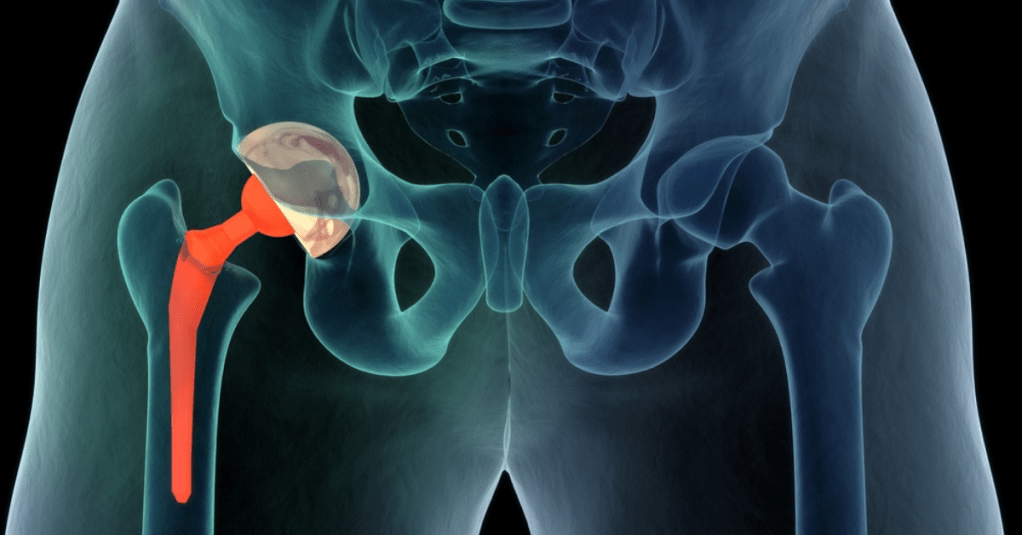
As we age, most of us will suffer from some form of osteoarthritis. Osteoarthritis is when the cartilage (that protects the ends of your bones) wears down and the bones of the joint grind against each other causing inflammation and pain. One common method of dealing with it is to replace the worn joint with an artificial one. Knees, hips, and shoulders are among the most commonly replaced joints.

If you are going to have replacement surgery, you want to do your part on getting the best outcome possible and to do that means strengthening the muscles surrounding the joint before going into surgery and rebuilding the strength and mobility of them after the surgery.

This is personal for me as I had my right shoulder replaced about 9 years ago and am having my right hip replaced on June 29th, 2021. My hip x-ray report stated “Severe degenerative changes with complete loss of the joint space with bone on bone apposition. There is osteophyte formation and subchondral sclerosis.” Now, you have to know that I am still teaching (and participating in) high-intensity weight training classes, have very good strength and mobility… just a lot of pain. The fact that my hip is strong and mobile will make the recovery from surgery much easier and quicker. (I’ll let you know how it goes.)

I’m not going to recommend any particular exercises that you should be doing because your program needs to be created based on your individual needs, what strength and mobility you currently have. I will share the standard guidelines with you, though.

Prior to having a joint replaced and while dealing with osteoarthritis the recommendations are, “While you may worry that exercising with osteoarthritis (OA) could harm your joints and cause more pain, research shows that people can and should exercise when they have osteoarthritis. In fact, exercise is considered the most effective, non-drug treatment for reducing pain and improving movement in patients with osteoarthritis.” (Arthritis Foundation) So, don’t wait to start, but be sure to get professional guidance.

Post-replacement recommendations not only include physical therapy, but also know that, “a critical part of the recovery process begins after the last physical therapy appointment ends. “You are already engaged in an exercise program,” says physical therapist Michele Hribar, PT. “Now you need to continue it for the rest of your life.” (Cleveland Clinic)

Joint replacement can greatly enhance the quality of your life. Do everything you can to assure the best outcome and make strength and mobility exercises part of your life.

Contingency Plans: ITTT

Let’s face it, our plans for the near future are out the window. In many states (and countries) people are finding themselves restricted to their homes and away from normal activities. This confinement or isolation, whether self-imposed or otherwise, can play havoc on our mental and physical wellbeing. We are now in new territory. How can we manage our behaviors and stay healthy?

Untitled design (84)

Start With Journaling.

In order to manage what we do, we need know what it is that we’re doing. Patterns are going to start to emerge and writing down what you do will help you decipher the good from the not so good. Set an alarm on your watch, your phone, Alexa, or other device to go off every hour. Stop what you’re doing and just note what you did in the last hour. i.e. 9-10am watched TV for 45 minutes, got up, made a cup of coffee and grabbed a danish, sat back down and continued watching TV. After a couple days of journaling, you will start to see the patterns, like grabbing that danish with your coffee each morning. Then, with it laid out in front of you, you can start to determine what needs to change. Make a list of those changes.

ITTT: If This, Then That

Take that list and come up with contingency plans. If this, then that (ITTT). Write down those plans.

Say that you know that danish is going to catch up to you and pack on a few pounds. ITTT, “If I get up for your coffee, then I will have a piece of fruit instead of the danish.

Maybe you realize that you’re sitting too much. ITTT, “If I sit for an hour, then I will go outside and walk around the house for 10 minutes before I sit down again.”

What if you find yourself feeling very anxious and fearful about what’s going on in the world. ITTT, “If I find myself thinking about COVI-19 and am fearful for myself and others, then I will take five minutes and meditate, focusing only on my breath. (Try the Headspace app)

You could also find yourself feeling very isolated these days. ITTT, “If I don’t talk to anybody outside of my household by the time I finish dinner, then I will call or face time one of my friends before I do anything else.” After all, social connection is very important to our mental health.

The use of ITTT is very much like stacking habits, but, hopefully you’re managing these behaviors before they actually become habits.

I hope this helps. It’s a new and stressful time for everyone and you’re not alone.

Stay safe. Stay healthy.

What if Starting a Fitness Program Was Easy?

Getting started always seems to be the hardest part. Once you’re going, it’s not as difficult to keep going. What if I told you that starting doesn’t have to be so hard? What if it was actually easy? The fact is, it can be.

What makes starting such a challenge? There are a number of things that can make it seem that way. Here are some of those:

  • You can’t find the time to exercise
  • You don’t have enough energy
  • You’re not motivated
  • Your body hurts and you don’t want it to hurt more
  • You’re not sure what to do
  • You’re where to do it
  • You can’t afford to do it

Untitled design (79)and here is the reality:

  • Time – You can literally start with just a few minutes
  • Energy – Starting with minimal time and effort doesn’t require much energy and, as you increase the time and effort, so will the amount of energy you have
  • Motivation – If you didn’t have at least a little motivation, you wouldn’t even be considering exercising and you only need a little if you are starting small.
  • Body discomfort – Moving more, even if it’s only a little more, decreases our sense of pain.
  • Unsure what to do – This is where consulting with a professional is important. Generic programs can be found online, but they will never be perfect for you.
  • Where – You can start right in your living room, your backyard, a park, or wherever you like, equipment is not necessary.
  • Affording it – The only real expense is hiring a professional to get you set up (and possibly to update your program periodically). This is an investment in your future and isn’t it worth getting it right rather than wasting your time and running the risk of hurting yourself with programs that aren’t going to get you where you want to go? BTW, this can also be more affordable than you may think.

So, knowing this, what’s holding you back from getting started?

Strength for a Lifetime… The Book

I’m starting to write my second book. My first was one for fitness professionals, The Business of Personal Training and teaching personal trainers about how to build their business is a passion of mine. However, this next book is for the individual that needs help getting started in a strength program, progressing with it, and continuing with it for a lifetime.

Untitled design (77)

The challenge for many people is that most books for the beginner explain how it all works and supplies the reader with exercises/workouts to do. It’s all very generic and not very individualized. What I hope to accomplish with my book is to explain the importance and basic concepts (as most books do) and then teach the reader how to structure, modify, progress, and grow their own workouts as they need. I want to empower the reader to take charge of physical capabilities, to live long, strong, active and independent lives.

As I map out the content, I’d love to hear about what frustrates you most about getting into shape and what the greatest physical challenges are for you. Please let me know in the comments. Thanks!